The scourge of the gardener is pests. And diseases. And critters that eat things you are trying to grow.  And too much rain. And not enough rain. Okay, so gardeners have several scourges.

If you are growing any of the cucurbit family of veggies, though, pests are high up on that list. So it was that I got up close and personal with the squash bug this summer. Or, to be more accurate, the squash bug's eggs.

While working in the garden one morning, my daughter and I noticed a grouping of light brownish spots on the underside of a zucchini plant leaf. A quick check of the Google revealed them to be the eggs of the squash bug.


The squash bug likes to lay its eggs in clusters on the underside of a squash leaf.


The eggs are often clustered near one of the leaf's main veins.


Squash bugs can decimate a garden, and quickly. I knew they had to go.

I'm not a huge fan of chemical insecticides and have tried (and so far have succeeded) to avoid using them in my garden. So rather than try to poison the bugs, I wanted to find a better way to put an end to their next generation.

The answer was as near as my garage: duct tape.

Yes, you can use duct tape to remove squash bug eggs. It is easy and effective, does no damage to the environment or your food supply, and is an immediate solution.

Step 1: Discover eggs. Curse the gardening gods. Then gird your loins for battle.

Step 2: Locate duct tape. Probably in the garage. This step may actually take you the longest amount of time...

Step 3: Cut off a four- to five-inch length of duct tape.

Step 4: Hold the tape so that it is draped over a finger or two (index finger tends to give best control).

Step 5: Gently press duct-tape-covered finger against clutch of eggs and then pull back. Check to see that the eggs all stuck to the tape. If you missed a couple, just touch them again.


Step 6: Marvel at yet another use for duct tape. In the garden. Who knew?

Step 7: Fold the piece of tape securely in half and, for extra measure, squish the two sides together to smush the eggs flat in between. Throw the egg-ridden folded tape in the trash, and take out the trash. Ick.


Even if the tape removes a portion of the leaf along with the eggs (as it did here), that tiny damage still is better than allowing the squash bug eggs to hatch into a crowd of voracious insects ready to destroy your hard gardening work.

After we discovered the first clutch of eggs, checking the undersides of leaves of our yellow squash and zucchini plants became a daily part of our garden work. Every few days, we would find another cluster of eggs. We used the duct tape solution to our squash bug egg problem each time, and it worked like a charm.

I only ever found two actual adult squash bugs, and they were easy enough to grab and kill by smushing. Sorry, squash bugs. You have got to go.

What pests have you discovered in your garden this year? How have you handled them?
The recent cool, rainy, grey weather here in the Philly 'burbs has had me worried. Not just for my own sanity - honestly, after this past winter, we all NEED some sunshine, amirite? - but also for the health of my latest obsession: tomatoes. Well, my garden overall, really.

But my weekly garden tour and assessment perhaps should put some of my fears to rest. Everything seems to be gaining in size and production, and, so far at least, staying ahead of pests and diseases. Here is the nickel tour.

This is the newest area of our garden. I created it in May, by moving an old garden bench we had between the windows to the back by the deck and putting the arbor in its place, along with other various containers - including the picnic basket, which I got for about $8 at our local thrift shop. At the far right, in the first crate, is a Black Cherry tomato.


This is an Early Girl. I don't think I'll plant this one again next year. It has not proven to be particularly early, nor particularly prolific.


This is an Indigo Rose tomato, which was bred at Oregon State University and released in 2012. I picked this up as a seedling from Ott's Exotic Plants in Schwenksville, Montgomery County, PA. Watching it develop has been a true pleasure, and the blue-black of the fruit is intriguing. (I'll post a close-up later) I'm looking forward to tasting it.


Next up is a Sun Sugar. This one, I actually purchased from Frederick's Flowers in Souderton, and it was already of substantial size when I bought it. The foliage is a little more yellowy - lime greenish than I'm used to on a tomato, so I don't know if that's because I'm doing something wrong, or if that's just how the plant looks. One of these little gems has ripened so far, and the taste is amazing. So incredibly sweet and fresh. I hope this one keeps producing.


Next, is a 4 x 4 raised bed that we installed last year. Below, you can see a Super Sweet 100s red cherry tomato (on the right) and to the left is a Mr. Stripey, an heirloom that ripens to a red with yellow stripes. I'm going to try saving seed from this one for use next year, or the year after.


At the front of the bed is a straightneck summer squash plant. If we're not careful, it might swallow the house. So far, it is producing well, and we are staying ahead of powdery mildew, a fungal disease with which we have had issues in past years. Keep your fingers crossed. And send squash recipes. Many, many squash recipes...


My husband's poor little jalapeno plant has been totally eclipsed by the squash, but it honestly doesn't seem to mind. Hidden under those leaves, it is still flowering and producing little baby peppers.


A better view of Mr. Stripey. You can just barely see the first few tomatoes in the middle.


The second 4 x 4 raised bed is by now a sprawling mound of vining plants. Left, zucchini. Right, toward the fence section, is a burpless cucumber that is producing faster than I can keep up. Bottom right corner is Blue Lake Bush Beans - which started as five "little" plants. I've never grown beans before, and I just noticed the first few have materialized, so I am beyond thrilled that they are (so far) growing. Bottom left corner, barely discernible under the zucchini leaves, is a cantaloupe plant. My daughter picked it out, but I have since learned that cantaloupe is somewhat difficult to grow, so I'm not surprised that it hasn't done much. Plus - with the Monster Zucchini for a neighbor, the poor thing probably gets little sun.


This is the first large-ish tomato to begin ripening. This is an Amish Paste, another heirloom variety that legend has it was collected from the Amish in Lancaster County, PA. It is supposed to be great for making tomato sauces, as it is very thick-walled with lots of flesh. I've never grown this one before, so we'll see how it turns out. The plant itself, I put in a pot that I now realize is too small for it - but I'm afraid to re-pot it into a larger grow bag, at this point.


Speaking of grow bags, below are two different kinds that I ordered after the tomato seeds that I started actually produced seedlings. (I've never started anythings - successfully - from seed before, so I was kind of surprised that it worked.) By the time the seedlings were established, I had already planted in every container I had and a few I had to buy. Grow bags were recommended to me by Craig LeHoullier, the author of Epic Tomatoes, which I admit I have read cover to cover. They have proven to be an economical alternative and the seedlings are flourishing. The two plastic grow bags are the kind Mr. LeHoullier said he uses, ordered from GrowOrganic.com; the two fabric ones are "Dirt Pots" I ordered on Amazon after checking literally every garden supply shop within miles. No one carried them locally. 

Unfortunately, the seedlings were desperate to be planted, and in the rush to get them in the soil, I forgot to mark which was which. I do know that the one in the back Dirt Pot is a Yellow Pear, an heirloom that produces small, pear-shaped sweet tomatoes. The other three are heirlooms too: a Black Krim (originally from Russia), Box Car Willie, and Cherokee Purple. I just don't know which is which, at this point.


I do have one more tomato, a Cherokee Purple that I bought as a seedling, but I forgot to take a picture of it. That will have to wait for the next update!

Are you growing anything this year? What is working and what isn't? I would love to hear your thoughts and stories.
Black raspberries are not blackberries. Blackberries are not black raspberries.

That's the first thing I have found myself explaining to well-intentioned people who have directed me to blackberries when what I asked for was black raspberries. It turns out there is a fair amount of confusion over the two. Once you've tasted real, honest-to-goodness black raspberries, though, you will never be confused about them again.


Fortunately, if you live near enough to Bucks County, Pennsylvania, there is an easy way to educate yourself and your taste buds. Penn-Vermont Fruit Farm, in Bedminster Township, offers pick-your-own black raspberries. They are in season now, and they are gorgeous.

Penn-Vermont is nestled along what is still today a country road, Bedminster Road, even though it also happens to be Rt. 113, an important connector road through the heart of Bucks County and its farm country. A drive to Penn-Vermont displays some of Bucks County's most beautiful scenic farm land, and is a relaxing way to spend any morning or afternoon.


The farm itself comprises nearly 60 acres and has been preserved for agricultural use through Bucks County's Agricultural Land Preservation Program, which has preserved more than 12,000 acres across the county since its founding in 1988. Owned by Ken and Judy Bupp since 1982, the farm is an amazing community resource. Taking kids to see a real farm is an education in and of itself, especially for kids who may live in urban or suburban environment disconnected from the places where fresh food is actually grown.

Nearly every time we've visited, the family that keeps the farm running is out in the fields, actually keeping the farm running. Note the farm equipment to the right of the photo below:


On this particular visit, my daughter and I were there with one thing in mind: black raspberries. Penn-Vermont had alerted followers on the farm's Facebook page that the berries, sometimes called "black caps" by growers, were ready. And since the season is relatively short, we didn't want to waste any time.

We weren't disappointed. After we checked in at the stand near the entrance to the farm, we picked up a carrier with six dry pint berry baskets and the helpful young lady directed us to the patch. "Head for the farthest rows - most people stop at the first rows, so the back rows have more."


We did as she suggested and headed for the rows farthest from the check-in stand. Within minutes, we were pulling gorgeously plump, shiny black raspberries off the canes and into our little baskets.

When perfectly ripe, black raspberries pull so easily off the core on the cane that they practically fall into your hand. Like most berries, they should be treated gently so as not to smush them.

When they do get smushed, the juice that leaks out leaves a gorgeous dark berry stain - just don't rub your hands on your clothes, especially not white clothes.

Though black raspberries can be grown across North America, most of the berries grown in the United States seem to come from Oregon - the Willamette Valley, specifically. That may be one explanation for why they can be so hard to find in other parts of the country.

The relative rarity can mean that black raspberries are a pricy choice in markets across the country. At the Penn-Vermont pick-your-own fields, however, cost was just $5 per dry pint.

Within about 30 minutes, we had filled two pint baskets to the brim with perfectly ripe, perfectly lovely black raspberries.


We headed for the stand to pay.


These berries are fated for two destinations: 1. a tiny batch of black raspberry preserves, and 2. our stomachs. They are so sweet and tart and tangy, I predict that we will eat most of them right away. Which is a good thing, because like most tender raspberries, they can go bad very quickly. Eating them right away, then, is really just doing them a kindness.

If you go:

What: Penn-Vermont Fruit Farm
Where: 831 Rolling Hills Rd., Bedminster, Bucks County, PA
Phone: 215-795-0230
Online: https://www.facebook.com/pages/Penn-Vermont-Fruit-Farm/107360655976304
Hours: Check the Facebook page or call before you go


Anyone who likes to cook - or eat - knows the power of fresh herbs.

Ripe tomatoes paired with sweet basil and fresh mozzarella make for an amazing pizza. Cilantro gives chicken tikka masala an extra layer of flavor. Parmesan and rosemary take bread dough from everyday to something special.

If you've bought a clump of fresh herbs from the grocery store, however, you know how expensive they can be - and how quickly they die. So early summer is the perfect time to create your own herb garden, and you can do it for about $20 (significantly less, if you start your plants from seed).


Step by step, here is how I planted this herb garden and how much it cost.

Materials:

  • 1 basket - free - This one was in my closet not being used. Be creative. Look around your house for a container and repurpose something you love as a home for your kitchen garden. If it can hold dirt, you can plant in it.
  • 1 terra cotta pot - free - I already had this in my garage. If you don't have a spare pot, it isn't strictly necessary, but you can buy one for less than $1, usually.
  • 2 coconut liners - $2 ($1 each from the Dollar Tree)
  • 1 liner - free - (OPTIONAL) This isn't necessary, but I wanted to line most of the basket so the soil wouldn't wash out with the water between the basket weave.
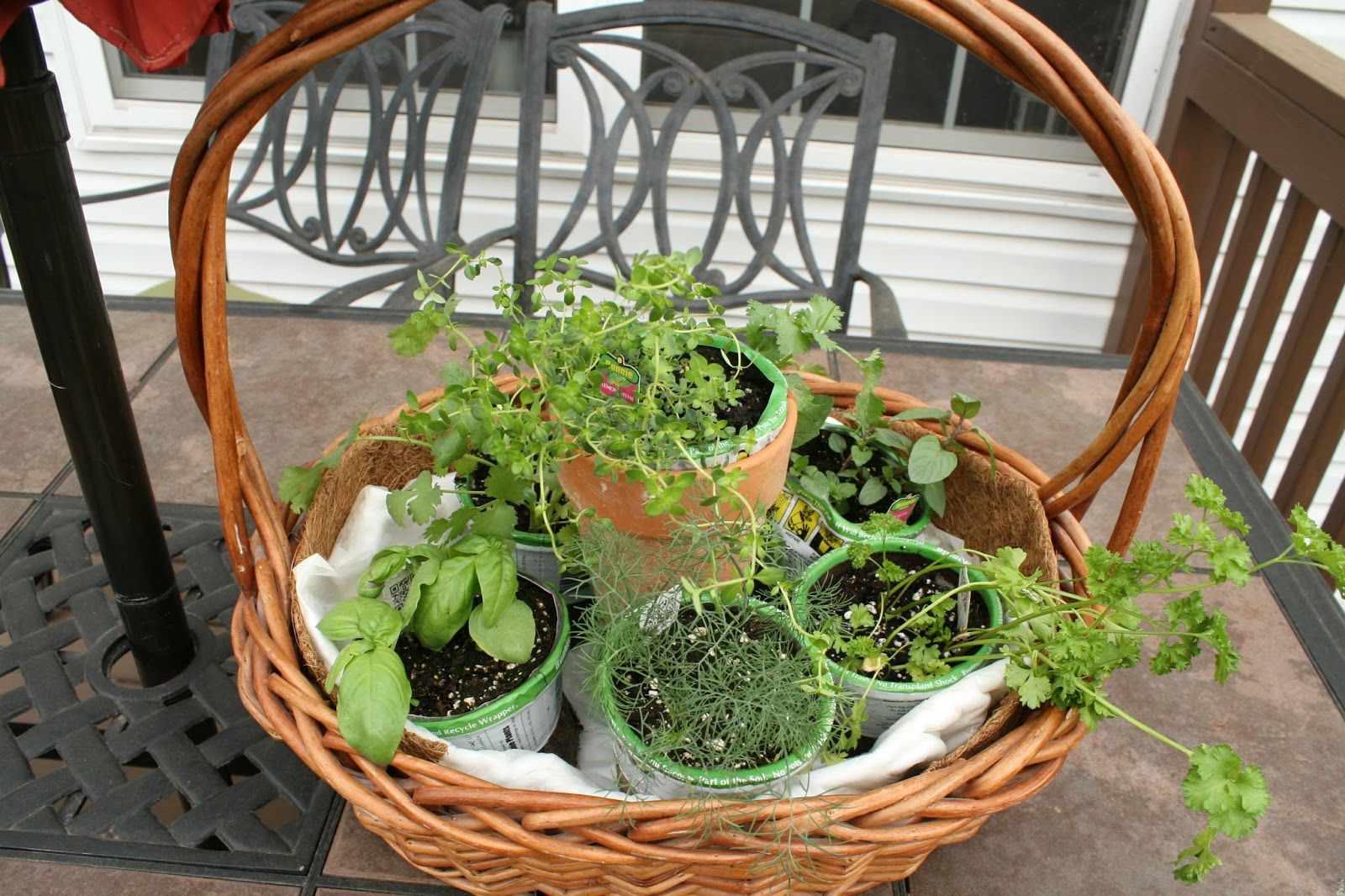
  • 6 plants - $15 - ($2.50 each) - Chose herbs that you love to taste, smell, and look at. I chose cilantro, fern leaf dill, chocolate mint, curley parsley, sweet basil, and lemon thyme.
  • Potting soil - $2 - I used part of a big bag that I split among several projects, so this is an estimate.


1. Cut slits in the coconut liners to get them to lie flatter and fill most of the basket or container.


2. Spread the liner (this is half of a pee pad leftover from our long-ago puppy training days) along the inside of the coconut liners, tucking the edges under so they won't be seen from the top once it is all planted.


3. If you want some height in the middle of the planted arrangement, use a pot or similar container and prop it up on something. Here I cut off the bottom half of a plastic plant container and turned it upside down in the middle of the basket.


4. Arrange the plants as you please. I like to place taller plants in the back and bushier plants so they trail over the edges.


Mmm, lemon thyme.


Mmmmm, sweet basil. Pesto, here we come....


5. Place enough potting soil to cover the bottom of the container. Mound it and firm it down around the elevated piece in the middle, if needed.


6. Nestle the plants into the container and fill in the spaces between with potting soil, firming as you go. Give it a good watering to help the plants settle into their new home.


Here's the finished product, on a table on my deck, within easy reach for last-minute picking to throw into recipes. Don't forget to actually harvest and *use* your herbs - that's what they're there for, and they produce more when they're picked often.


Have a great use for fresh herbs? Share your ideas in the comments.

The paper is brittle and yellowed, the ink fading away in spots. The man and woman stand side by side, barely touching, and with only the trace of a smile on their faces.


The wedding portrait of Anna Holden and Harry L. Wilson is one of my most treasured family heirlooms, but it didn't start out that way. The photo of my great grandparents was found tumbled amongst a heap of old photographs of nameless faces in a box passed on to me after my grandmother, Marion Wilson Larson, died in 1992. When I became interested in genealogy in 1999, I opened that box and began searching the faces of the people staring up at me. Who were they? Where had they come from? How were they related to my grandmother, to my father, to me?

Before the mid-1800s, of course, those questions never could have been asked, much less answered. The commercial introduction of photography in 1839, however, eventually made it possible for great great grandchildren to gaze upon the faces of long-dead relatives they had never met. Photography, at first reserved for the elite, eventually became accessible even to the farmers of Fulton County, Illinois, where Anna and Harry and their families had lived.

The family portraits for which they posed formed a thread that later would connect my present back to my past. Years worth of investigation eventually enabled me to match the vast majority of those once-unknown faces with their names.

But the fact that I even had to investigate to discover who these family members were should illustrate just how fragile our connection to our past is. And in some cases, that link can be broken forever.

So it was that I found myself crouched on the floor of an antique store in Bucks County, Pa., one recent afternoon, sifting through someone else's family treasures. Instead of being passed down to a family member - however unwitting that family member initially may have been - these treasures had been cast away. They were now staring up at passers by from boxes and bins and frames on shelves. Memories for sale.


For just $3, you, too, could own a little piece of someone else's family story. Such as this portrait of a couple on what is likely their wedding day.


Or this one of a happy bride and groom and their attendants.


Or these portraits of dapper young military men.


I touched each photo lightly, holding it by the edges. The oils transferred from careless hands can destroy old photographs. It was likely, however, that few other hands had been as careful over the years. Did the care I took in holding those photographs - those parts to someone else's family story - matter? Was I the last person to "care" for these strangers, for whatever wisps of their presence had been captured by silver nitrate to proclaim that they had lived?

A historian friend reminded me that it has been said that we die two deaths: our actual death, and another death when the last person who remembers us dies.

What was the name of the young man frozen forever in his military uniform? Did the young bride who smiled slightly up from her wedding portrait ever have children? Did she like iced tea? Did he know how to whistle?

I didn't know these people. I don't remember them, and the answers to the questions I would ask are almost certainly lost forever. For one brief moment, though, they lived again in my palms, staring out at me from the past, mutely asserting that they had lived and loved however long ago.

Genealogy can be a lonely, obsessive pursuit, and one that doesn't always seem to have an obvious benefit. By the time I set those photos of strangers back down in their antique shop bins, they had whispered confirmation of what I already knew in my heart: it is my job to ensure that Anna Holden and Harry L. Wilson do not end up staring into the eyes of a thrift shop customer in the 2050s.

It may be years before my children care to learn how the stories of their lives are entwined with the stories of those who had come before them, of the great great great grandparents who left behind everything they had known to set sail for America and the hope of new, prosperous lives. When they are ready, however, it is my job to ensure that our fables and our photos still survive, to be bequeathed to the care of the next generation to tell our family story.
They came by the thousands, a steady stream of men, women and children dressed in their best, tears in their eyes, mourning badges pinned to their clothes. By one count, more than 7,000 people shuffled past his casket each hour.

Hours upon hours later, as the body of murdered President Abraham Lincoln was carried away from the Cook County Court House back to the funeral train to make the final leg of its solemn journey toward Springfield, the Chicago Tribune estimated that 36,000 people had taken part in the funeral procession, and 100,000 had crowded the streets to witness the procession.

"No community has done itself such peculiar honor as Chicago did yesterday, by the vast magnitude, the perfect order and solemn beauty of the funeral procession," proclaimed the newspaper on May 2, 1865. "The most careful estimates by time and actual count show that thirty-six thousand people participated in the procession as members of organized military, civic, municipal, educational, religious or other associations, apart from the immense numbers, amounting to at least one hundred thousand citizens, who thronged the line of the procession from curb-stone to house top."

Only five years before, the city of Chicago had hosted the Republican National Convention, where the jubilant party faithful had chosen the man who now lay dead - "a man known to the public only for his inflexible honesty and sterling common sense" - to represent their party on the ballot for president and to "reverse the policy of the country in regard to" slavery.

Like generations of Illinois schoolchildren before me, I learned the details of our former president's life and even felt a sort of pride of relation. Growing up in the "Land of Lincoln" makes one acutely aware of the much-revered traits of honesty and integrity for which Lincoln was justifiably renowned.

That academic connection took on a far more personal tenor, however, one day in 1999, when I discovered a brittle, yellowed print among a collection of family photos that I had inherited.

The depiction on the front showed a train.


The handwriting on the back showed why that photo had been kept amongst our family's heirlooms for decades. "Train that carried Lincoln's body from Wash. to Ill."


Shot in the head while watching a play with his wife, Lincoln died the morning of April 15, 1865 - 150 years ago today. It had been just six days since Robert E. Lee surrendered to Ulysses S. Grant at Appomattox Courthouse to end the Civil War. Already torn apart by war and personal loss, much of the nation was plunged into grief and shock at the loss of the president. Though a funeral was held in Washington, D.C., that was not enough. The people needed to pay their respects.

"In an age before television or radio, the only way for a person to participate was to leave her farm or close his store and physically go to a funeral procession where Lincoln lay in state," writes Ainissa Ramirez, in Time magazine. "Lincoln's funeral train allowed the nation to mourn in unison by bringing him to them in a way that neither telegraph nor newspapers could satisfy."

And so began what many historians have called the longest funeral in history.

The United States, a private train car which had been built so that Lincoln would have a means to travel the country to unite the people after the Civil War, instead was outfitted as a hearse car. It carried Lincoln's body on a 13-day, 1,600-mile route from Washington, D.C. to the murdered president's final resting place in the Illinois state capital of Springfield.

A pilot train ran ahead of the funeral train, sounding a solemn bell to give notice to the people. Then the funeral train itself - a portrait of the president mounted above the cattle catcher and black mourning cloth draping the hearse car - would arrive, passing solemnly at no more than 20 miles per hour through each and every community.

An estimated 1.5 million people turned out along the route to bear witness to the president's passing, some traveling to cities to view or participate in elaborate funeral ceremonies, others lining dusty crossroads in the countryside. They came at all hours of the day and night. The president of the New York Central Railroad, who was aboard the funeral train, said, "As we sped over the rails at night, the scene was the most pathetic ever witnessed. At every crossroads the glare of innumerable torches illuminated the whole population, kneeling on the ground."

As the train neared Lincoln's home state and approached Chicago, emotions were high. Newspapers had printed daily updates, dispatched from reporters accompanying the funeral procession, and the people had followed along.

INDIANAPOLIS, Sunday - Midnight
The remains have been placed on the train, and we resume our journey to Chicago. On the way we pass in succession Augusta and Zionsville. These are small places, but it seems the inhabitants are on the roadside. Some of them hold torches in their hands, and the surroundings are solemnly lighted up. Men stand with uncovered heads as the train hurries on its way. - The New York Times, May 1, 1865

By the time the train finally reached Chicago, the city was virtually shut down.

"There was none of the hum of business; none of the rush and whirl and hot haste that characterize Chicago, - but closed stores, silent streets and sadness resting on all faces," wrote U.S. Sanitary Commission activist Mary A. Livermore. "Flags bound with crape floated mournfully at half-mast. Black draperies shrouded the buildings. All talk was low and brief. Many wept as they walked, and on the breast or arm of all were mourning badges. All nationalities, creeds, and sects were ranged along the route to be taken by the funeral cortege, or stood amid the solemn pageantry and funeral splendor of the great procession."

At the time of Lincoln's death, my paternal ancestors - the Wilsons, Holdens, Garretts and Campbells - lived on farms in Fulton County, Illinois. The first husband of my great great great grandmother Mary (Rounds) Garrett, whose name was John W. Shores, had responded to Lincoln's call for more troops in the early years of the Civil War. Shores enlisted in Company G of the 85th Illinois Infantry in August 1862. He was killed in the Battle of Kennesaw Mountain, Georgia, on June 27, 1864, fighting for the ideals in which Lincoln had believed so fervently.

Meanwhile, my maternal ancestors, the Blackburns, still had lived in Pennsylvania in the 1860s but shortly would move to Nebraska, where my great grandfather Ross Milward Blackburn was born. As a young man, Ross took a job with the Chicago & North Western Railway offices in Iowa. In 1905, he was transferred to the company's Chicago office. He worked for the railroad his entire life. It was among the photos from his side of the family where I found the image of Lincoln's funeral train, with the note on the back written in an (as yet) unknown hand.

Who originally had obtained the photo? Who had tucked it away amidst the baby pictures and wedding portraits of the Blackburn and Piehl families?

Moments after Lincoln died in a bedroom at the Petersen boarding house, across the street from Ford’s Theater, the Secretary of War, Edwin Stanton, reputedly said, “Now he belongs to the ages.”

And so he does. But one of my forebears took time to preserve this photographic copy of a copy of a relic of a quintessentially American saint. Perhaps they hoped that by doing so, they too could lay claim to some infinitesimal part of him. They were confident enough in the success of their efforts to make the photo a family heirloom, preserved across the decades. And now, 150 years later, those 1,600 miles of rail have led to a shelf in a closet in my home, where a photo of Lincoln's funeral train laid where it has for decades, folded in amongst photos of somber newlyweds and round-cheeked babies.

I want to follow those rails back where they came from. I want to meet the people who kneeled with lanterns in the night as the fallen President passed by on his journey into the ages. They are my people, and they, too, belong to the ages. But if we take the time to listen to their whispering — and they never stop whispering, which is perhaps why we listen so rarely — the ages also can belong to us.
If you've ever had one of those days when chocolate chip cookie dough sounded like a great dinner, this post is for you.

I've had lots of those days recently, but what I don't have lots of is time to bake. So I put my freezer to good use once again, and spent a Sunday afternoon mixing up a batch of chocolate chip cookie dough to stash away for desperate times.

Because yes, Virginia, you can freeze cookie dough.

My favorite recipe by far is the one on the back of the Ghirardelli chocolate chip bag.


I knew I wanted to be able to pull the cookie dough out of the freezer a few at a time, so I could bake them a few at a time. Or eat the cookie dough a few at a time...

So the next step was to shape them into balls. I do not have a cookie scoop, so I just used a spoon, but I of course started eyeing cookie scoops. I'm trying to reduce the amount of stuff in our house these days, though, so I am resisting buying one. We'll see how that works out. Resistance is sometimes futile.


Shape the dough into balls and place them on a cookie sheet lined with parchment paper. You can crowd the balls of dough close, because you're just going to stick them in the freezer, so they don't need room to expand.

After a couple hours in the freezer, the dough was nice and firm. I pulled them all off the cookie sheet and put them into a freezer bag. PLEASE label and date the bag. You will thank yourself later.


Squeeze as much air out as you can, and stick the bag in the freezer. Then you are ready to bake fresh cookies whenever you want. Unless you just want to eat the cookie dough. Not that I've been doing that or anything.